Thursday, May 20, 2010

Sermon on the Feast of Pentecost

by St. John Chrysostom
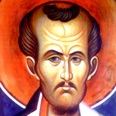
Our father among the saints John Chrysostom, Archbishop of Constantinople, was a notable Christian bishop and preacher from the fourth and fifth centuries in Syria and Constantinople. He is famous for eloquence in public speaking and his denunciation of abuse of authority in the Church and in the Roman Empire of the time. His banishments demonstrated that secular powers had strong influence in the eastern Church at this period in history.
Let us spiritually extol the grace of the Holy Spirit in spiritual hymns, since spiritual grace has on this day shown upon us from heaven. Though our words are too weak to express adequately the greatness of this grace, we shall praise its power and activity to the extent of our abilities; for the Holy Spirit probes all things, even the depths of divinity.
We are celebrating the day of Pentecost, the day of the Descent of the Holy Spirit to the Apostles, the day of the hope of perfection, the end of expectation, the longing for salvation, the fulfillment of prayer and the image of patience. Today the Spirit Who acted to scatter the nations in the time of Heber has formed tongues of fire among the Apostles. His action of old led to the confusion of the nations, in order to restrain the will of man from its brazenness and consequent chastisement; on this occasion, however, amidst fiery tongues, the deeds wrought by the activity of the Holy Spirit served to preserve us as recipients of preaching, in fulfillment of the will of God.
In the beginning the Spirit of God moved over the water, and later, in the time of Christ, the same Holy Spirit of God rested upon him . Then He moved, and now He rested, as being one in essence, equal in honor, ever-existent and unoriginate together with the Father and the Son.
He Who by the flight of a dove over the waters of the Flood heralded fair weather to Noah, the same Holy Spirit, by the sight of a dove at the waters of the Jordan, showed the world the Sonship of Him Who was baptized. Moreover, the Lord had a terrifying answer for those who dared to utter blasphemy against the Holy Spirit:
“Whoever speaks  blasphemy against the Holy Spirit, it shall not be forgiven him, neither in this world, neither in the world to come.”
David, declaring his desire for this Holy Spirit, prayed to God, saying: “Cast me not away from Thy presence, O Lord; and take not Thy Holy Spirit from me.”
As is well known, where He is absent, every sort of corruption sets in. Thus, the Spirit of the Lord departed from Saul, and an evil spirit entered into him, wherefore David said,
“Take not Thy Holy Spirit from me.”
This same Holy Spirit sanctified the prophets, instructed the apostles and empowered the mar­tyrs. This same Holy Spirit consecrated Isaiah, taught Ezekiel and revealed the resurrection of the dead. As he says,
“The hand of the Lord was upon me, and carried me out in the spirit of the Lord.”
This same Holy Spirit chose Jeremiah from his mother’s womb, and raised up Daniel to deliver Susanna. As it is written,
“God raised up by the Holy Spirit a young youth, whose name was Daniel.”
David so loved the presence of this same Holy Spirit that he prayed to God, saving,
“Thy Holy Spirit shall lead me in the land of uprightness.”
This same Holy Spirit of God came to dwell in the holy Virgin Mary, embracing her with the communion of the Divine Word at the good pleasure of the Father, and making her the Theotokos. Elizabeth, being filled with this same Holy Spirit, understood that the Lord had come to her by means of the Virgin; wherefore she said,
“And whence is this to me, that the Mother of my Lord should come to me?”
Zachariah, the father of John, was filled with the same Holy Spirit, whereby he declared that the son born to him would be the prophet and forerunner of the King Who was to come. John himself was also filled with the same Holy Spirit; the eyes of his intellect were given light, and he beheld the heavens opened, and the Holy Spirit hovering over Him Who was being bap­tized, Him Who baptized with the Spirit and fire.
By the action of the same Holy Spirit, the Lord Himself, when He was giving His Apostles His teaching in detail and strength­ening their minds for the time of His Passion, said to them:
“If I go not away, the Com­forter will not come unto you.”
Moreover, revealing to them the Spirit’s consubstantial power, He said:
“When the Holy Spirit is come, Which proceedeth from the Father, He will guide you into all truth.”
The holy Apostles waited expectantly for the coming of the power of this same Holy Spirit; they waited together to be clothed with power from on high, according to the commandment of the Lord, Who had said:
“Tarry ye in the city of Jerusalem, until ye be endued with power from on high; for, behold, I shall send the promise of My Father upon you.”
And, as it is written,
“when the day of Pentecost was fully come, all the holy Apostles were assembled with one accord in one place, and the Paraclete was sent to them under the appearance of tongues of fire.”
Having received the abundant promise of the Father and the Holy Spirit, they were strengthened, and they manifested Him Who was sent to them, His grace and His power. The martyr and protodeacon Stephen, filled with the same Holy Spirit, Whom he received by the laying-on of hands of the Apostles, did great wonders and miracles among the people. Being full of the Holy Spirit, he saw the doors of heaven opened and the Only-begotten Son and Word of God standing in the flesh at the right hand of the power of God. Filled with this same Holy Spirit, Paul became the preacher of divine mysteries. As Ananias said to him:
“The Lord, even the Savior, hath sent me to thee, that thou mightest receive thy sight, and be filled with the Holy Spirit.”
And Paul afterwards said with assurance:
“And I think also that I have the Spirit of God.”
The same Holy Spirit came to Cornelius and those that were to be baptized with him, and each of them spoke in his own tongue and magnified God. This same Holy Spirit came upon the Ethiopian eunuch after he went down into the water [of baptism], and he was filled with joy, and he went on his way rejoicing.
This is the same Holy Spirit Who preached by the prophets, Who gave understanding to the apostles, Who spoke to men. He was given to them by the Lord, and all their adversaries were not able to gainsay or resist Him. For, as the Lord said,
“It is not ye that speak, but the Spirit of your Father Which speaketh in you.”
This Holy Spirit also or­dains priests, consecrates churches, purifies altars, perfects sacrifices and cleanses people of their sins. This Holy Spirit abides with the godly, refines the righteous and guides kings. This same Holy Spirit preserved the soul of Simeon, lengthening the time of his life and re­versing the rules of death, until the day when he beheld Him Who is the Redeemer of life and death; for it had been promised unto him by the Holy Spirit, that he should not see death before he had seen the Lord’s Christ.
It was the same Holy Spirit Who gave strength to Elijah, and Whose power Elisha desired when he asked of Elijah:
“Let there be, I pray thee, a double portion of thy spirit upon me.”
This Holy Spirit enlightens souls and sanctifies bodies. It was the same Holy Spirit Who descended upon the Apostles and filled them with divine wisdom. Having received His gifts, they were all filled with the knowledge of God; not only were they given divine knowledge, but also spiritual gifts.
Simon Magus, being a stranger to the Holy Spirit, fell to his perdition. As Peter said to Simon:
“Thy money perish with thee, because thou hast desired to purchase the priceless grace of the Holy Spirit with money.”
Therefore, beloved, let us strive to keep our bodies uncorrupted; for one who has acquired a new body, which is a temple of the Holy Spirit, has become a true victor over the devil. What the Spirit of God has said, may it be done unto me.
Moreover, Joseph, strength­ened by this same Holy Spirit, desired not that his body be defiled by the vile deeds of this life; for he knew that the Spirit does not abide in a body that has commerce with sin; there­fore, he attained a royal rank. This Spirit enlightened Bezaleel, so that he fashioned the tabernacle with all beauty and skill. Joshua the son of Nun, possessing the same Spirit, be­came a faithful heir to Moses and obtained the inheritance of the Promised Land for his people. As God said to Moses:
“Take to thyself Joshua the son of Nun, a man who has the Spirit of God in him.”
This is the Spirit of Whom the Lord, when He breathed upon His disciples after His Resurrection from the dead on the third day, said:
“Receive ye the Holy Spirit.”
And again, it is the same Spirit Who has vouchsafed to give eternal life to the faithful after the general resurrection from the dead. As it is written:
“Thou wilt send forth Thy Spirit, and they shall be created; and Thou shalt renew the face of the earth.”
Many are the gifts of the Holy Spirit; many and all-powerful are His gifts.
As it says in a certain place: By the Word of the Lord were the heavens established, and all the might of them by the Spirit of His mouth. And Isaiah says:
“The Spirit of God shall rest upon him, the spirit of wisdom and understanding, the spirit of counsel and strength, the spirit of knowledge and godliness.”
And Paul adds,
“The Spirit of adoption and of grace.”
He Who is equally ever-existent, and equally unoriginate, and Who shares the throne and the honor of God, His Son and Word, called this Spirit the Spirit Who is our Comforter. David calls Him the Holy Spirit, since the Holy Spirit is sent by holiness; the governing Spirit, since He has dominion over all, be­cause all things came from Him and are kept in existence by Him; and the good Spirit, since salvation and all kinds of goodness are from Him.
And what does Isaiah call Him? The Spirit of God, because He proceeds from God the Father; thus does God Himself speak of the Spirit of God as proceeding, in the words, Which proceedeth from the Father. Isaiah further calls Him the Spirit of wisdom and understanding, because all wisdom and good understanding have been given through Him; and the Spirit of counsel and strength, because He is able to bring to pass that which is desired; and also the Spirit of knowledge and godliness. Ezekiel, a man of the spirit, says:
“And I will give you a new heart and a new Spirit.”
He is one in essence, one in principle and one in counsel with the Father and the Son. Wouldst thou believe? Listen to what the Scriptures say of Him:
“When He prepared the heaven, I was present with Him.”
The prophet further says:
“The Lord, and His Spirit hath sent me.”
Lest anyone think, from what was said, that this new Spirit would come from any creatures living or yet to come, or from any other person, He says:
“And I will put My Spirit in you;”
inasmuch as He said,
“A new Spirit.”
In the Acts of the holy Apostles, this was ex­pressed in commandments:
“The Holy Spirit said, ‘Separate me Barnabas and Saul for the work whereunto I have called them.’”
And again,
“It seemed good to the Holy Spirit, and to us;”
even as it had been said,
“I will put My Spirit in you.”
Would you demonstrate that this was indeed His coming, as was foretold in parables, and that it was His grace acting upon the holy Apostles? Will you believe what was said? Listen to St. John the Evangelist, who says:
“The Holy Spirit was not yet given, because that Jesus was not yet glorified.”
Paul called this Spirit the Spirit of adoption and the Spirit of grace, inasmuch as in the waters of the baptismal font men are born again of water and the Spirit, and we receive the adoption of sons. In the same way, the Lord said to Nicodemus:
“Except a man be born of water and of the Spirit, he cannot enter into the kingdom of God.”
Thus, the Holy Spirit is the Spirit of sonship and the Spirit of grace; for grace and truth came by Jesus Christ, through the Holy Spirit, for those who have been born by the power of God.
Moreover, the Spirit is called the Comforter, because He is also our advocate with the Father. And not only is He with the Father, but He is always with us also as a gift.
“And I will pray the Father, and He shall give you another Comforter, that He may abide with you forever,”
comforting your hearts and making them steadfast in divine patience and trust in Christ. Whereas the holy Apostles re­ceived this testament after Christ’s holy Rising from the dead, and were sent forth to teach and to baptize in the name of the Father and of the Son and of the Holy Spirit, and whereas we have already been vouchsafed this true washing by the Holy Spirit, let us strive to keep our souls and our bodies undefiled as we glorify the Most holy and consubstantial Trinity, the Father and the Son and the Holy Spirit, now and ever and unto the ages of ages. Amen.
© 2010, Preachers Institute | The Orthodox Christian Homiletics Resource. All rights reserved. On republishing this, please provide a link to the original post.

Thursday, May 13, 2010

What is the Rapture - Part Two

by Fr. Dimitry Cozby
Let us summarize what we have found so far. St. Paul does speak of a sort of rapture, in the sense of a carrying up into the sky of the righteous at the time of the Second Coming. The Fathers generally agree on that . But St. Paul and the Fathers see this as an event which accompanies Christ’s return and immediately precedes the Judgment and the establishment of the Kingdom.
The Rapture which Darby and Scofield taught and which Lindsey, Walvoord, and others still teach is different from that. They talk about it as a separate happening, part of a decades long program of events leading up to Christ’s Coming. The dispensationalists see the Rapture as the disappearance of the faithful from the earth before the Great Tribulation and many years before the Judgment. This is foreign to the Apostle and to the Tradition.
St. Paul mentions no period of affliction and persecution following the Rapture.
In an effort to forge a link between the Rapture and the Tribulation, supporters turn to Matthew 24:40-42, quoted above (in part 1). Certainly we have here references to a time of horror and suffering, and 24:21 even speaks of “great tribulation” (but not “the Great Tribulation”). Matthew 24 and 25 comprise a long discourse by Jesus. The occasion for this teaching is the first days of Holy Week, when Christ and His disciples were in Jerusalem on that last visit which ended in His death and resurrection. The Lord and His entourage have been in the Temple. As they leave, one of the company remarks on the structure’s splendor and grandeur (24:1-2).
Jesus replies by prophesying its coming destruction, which took place some 40 years later (70 AD). The group proceeds to the Mount of Olives, across the Kedron Valley from the city. They halt at a place which even today offers an admirable panorama of the Old City and the Temple site. The disciples, perhaps alarmed by Christ’s words, ask when “these things,” meaning the Temple’s destruction, will happen and what will be the signs of Christ’s return.
Christ’s sermon is His response to these questions. In order to understand it properly we must remember that there were two questions, one about disasters which would befall Jerusalem during the Roman-Jewish War of 66-72, the other about the end of time. Parts of the speech address one concern, some the other.
Much of what Christ says is intended to keep His followers from confusing the two events, taking the horror of the Jewish War as a sign of the Second Coming. We see this in the warnings He gives: that the Gospel must be preached in the whole world before the end comes (vs. 8), that many deceivers will arise claiming to be Him (verses 23-26), that no one knows “the day or the hour” except the Father (vs. 36), and many more.
Christ is concerned that His followers not confuse the impending disasters in Judea with the cataclysms of the end. To make His point clear He emphasizes the suddenness and unpredictability of His return.
We must interpret 24:40-42 in light of Christ’s insistence that He will return
“at an hour you do not expect” (24:44).
It would seem strange if Christ were to make this point over and over in the early verses of chapter 24, then in verses 40-42 describe an occurrence which would certainly tip everyone off that something was about to happen, and all the more peculiar if that tip-off were to happen seven years before His appearance, as the dispensationalists assert. The key to understanding the passage is the Greek word normally translated “taken.” The word (“paralambano”) has two meanings.
The first we might render “to take,” but not in the sense of “to lift up,” the meaning which the dispensationalists give it. It means instead “to bring along,” as in English we might say that someone takes a friend to the movies. That does not seem to fit the use of the word in Matthew 24, so we turn to the second meaning, “to accept” or “to choose.” Either of these words would be better in these verses than the imprecise “take.”
This second meaning fits with what the Lord has been saying in the passage in question, that His followers must be ready for His coming lest they be caught off-guard like the world, unprepared for the Judgment. Some will have heeded His commandments, will face the Judgment in confidence, and will be “accepted” into the Kingdom. Others, though living and working with the first group, day by day, will not have lived the life of the Gospel and will not be chosen or accepted by Christ when He returns.
These verses form part of Christ’s exhortation to all who hear Him to respond to His message and thereby avoid condemnation at the End.
The verses do not supply the idea of the Rapture.

Conclusion

What conclusions can we draw from our discussion? As we have seen, neither of the two passages upon which advocates of the Rapture rely mean what they say they do. Both refer to Christ’s final return. Those who support this doctrine neglect the context of the verses they use, distort the meanings of words and verses, and, in one case, take advantage of a loose translation. We must approach the Bible with more reverence. We must avoid pulling verses out of context. Instead, look at the surrounding verses to see what the Biblical writer is talking about and how that may affect your interpretation of a problem verse.
Beware, also, of interpretations which disagree with or attack the Tradition of the Church.
As we saw in our discussion of 1 Thessalonians 4:17, the Fathers of the Church pointed the way to the proper understanding of the verse. We must investigate the origin of ideas which other groups advocate, especially when they seem to contradict Orthodoxy.
The concept of the pre-Tribulation Rapture only appeared in England about 150 years ago. Orthodox Christians of great piety and learning have been reading the Scriptures for 2000 years. Would an important doctrine have escaped their notice? Very often these new doctrines do not really come from a careful reading of the Bible but from “special revelations”; their adherents have then ransacked the Scriptures for difficult or obscure verses which they can use to support them. Sometimes they arise when a reader tries to make sense out of hard-to-understand passages and does not succeed.
Orthodox Christians have the living witness of the Holy Spirit who, as Christ said, will guide us to all truth (John 16:13), and we also have the tradition of the Fathers to help us in our search. These are not two different sources but one and the same thing. The Fathers knew and listened to the voice of the Spirit; they affirm that the Spirit lives in the Church even up to the present day; they are one of the ways the Spirit has chosen to continue His work of teaching and guiding.
Trying to make the Bible support one’s own preconceived notions or insisting on one’s own limited understanding without seeking the guidance of Holy Tradition will not lead us to a true appreciation of what the Bible says or of what God says to us through it.
Sometimes too, the groups which support these new teachings are anti-Church. In their view the Church, and the Christian’s life in it, plays no part in preparation for the Second Coming and the Judgment.
In fact, membership in most religious groups is a hindrance, since they have abandoned the Gospel. The dispensationalists emphasize the individual independent congregation, “where the Bible is believed and preached,” as they often say. They advise the Christian to shop around until he finds a congregation which, in his personal opinion, fills this criterion. The Rapture doctrine reflects this; it will reveal those who have been the true “Bible – believing” Christians (their people), because these will be the ones to disappear, leaving the rest to face the Tribulation.
The dispensationalist view of the Church entraps us in circulation reasoning.
Following it means you must look for a congregation where you can learn their “true Gospel,” yet you must know that Gospel in order to judge whether it is taught in that congregation or not. The individual, weak and ignorant and sinful as he or she is, becomes the final judge of truth. Doesn’t it seem more logical to turn instead to the institution which Christ founded to preserve and to propagate His Gospel and to cleanse and strengthen its members through His sacraments? As the Ethiopian said to St. Philip,
“How can I understand if no one guides me?” (Acts 8:31)
We have a guide, the Church, where we can still learn the Gospel which Christ taught, the Apostles proclaimed, the Fathers defined, and the Martyrs confessed with their last breath.
Finally, we must keep our perspective and not give less significant doctrines an importance they do not deserve. Even if the dispensationalist understanding of the Rapture were true, should we give it the emphasis that they do? Dispensationalism generally places the greatest importance on the time-table of the Second Coming and on determining the order of events leading up to it.
This is not what is important to the New Testament authors or to Christ Himself, as His own words testify. Recall the passage discussed above from Matthew 24 and 25. Christ stressed that no one could predict when He would return. His primary concern was to exhort His followers (us) to be ready for His return. What we must know about the Second Coming and the Judgment is not when it will be or what occurrences will precede it, but whether we are ready to face it.
Have we committed our lives to Christ’s Gospel?
Are you living lives of repentance and faith?
Have we drawn near to Him in fervent prayer, diligent reading of the Scriptures and frequent and sincere reception of the Sacraments?
Are we using the grace of the Spirit imparted to us by Christ to grow in the Father’s image and likeness?
The answers to these questions are more important than whether the Rapture immediately precedes the Judgment or occurs seven years earlier. We must resist anything such as speculation about the end which distracts us from our salvation. Christ spoke often of the last days, but always with one purpose: to incite us to repentance and to encourage us to grow in His Gospel and to persevere in the Faith.
If we respond to His exhortation, then, when He returns, we will go to meet Him in the clouds, escort Him to His Judgment Seat, and stand at His Right Hand with the prophets, the apostles, the martyrs and all the saints, ready to enter the glory of His Kingdom.
Source
© 2010, Preachers Institute | The Premier Orthodox Christian Homiletics Resource. All rights reserved. On republishing this, please provide a link to the original post.

What is the Rapture - Part One

by Fr. Dimitry Cozby
Some of our evangelical or pentecostal neighbors occasionally speak about “the Rapture” as one of the events leading up to Christ’s Second Coming. By this they mean the physical removal from earth of the true believers in Christ in preparation for the “Great Tribulation,” a seven-year period of unparalleled calamity which will herald the end. (A few advocates say that the Rapture will follow the Tribulation. Most who believe in it, however, contend that it precedes the Tribulation.) The Rapture’s purpose, according to its advocates, is to safeguard the righteous during that horrible time. Its most familiar champions are Hal Lindsey (author of The Late, Great Planet Earth and other books), John T. Walvoord (of Dallas Theological Seminary), and the late Cyrus Scofield (author of The Scofield Reference Bible).
These ideas are popular with groups who are enchanted, even obsessed, with speculation about the Second Coming and who have convinced themselves that they see in current events signs that His return is near. These speculations form part of a broader ideology called “dispensationalism.” Dispensationalists come in all shapes and sizes and what we say about one may not apply to all. Still we can list some general characteristics which virtually all dispensationalists share. The name comes from their division of history into eras or “dispensations.” They believe that the Bible outlines the whole course of mankind’s religious history.
Each stage in God’s program is a dispensation, and in each dispensation God relates to the world and His chosen peoples in a different way. Some dispensationalist schemes encompass all human history; others include only Christian history since the time of Christ. Most often these systems are based on a symbolic interpretation of the “letters to the seven churches” of Revelation 2 and 3, with each church standing for the Christianity of a particular period. (Since dispensationalism is Protestant in origin its “Church history” is strictly Western. The dispensations take into account almost nothing of Orthodox history after the period of the early councils which we share with the West.)
The dispensational system includes the future as well as the past. Thus dispensationalism presents a detailed program of events leading up to the Second Coming. Two of the events in this master plan are the Rapture and the Great Tribulation.
Such opinions seem odd to Orthodox Christians. Still, strange as they are, we cannot turn our backs on them or their advocates. After all, the Orthodox Church too affirms that Christ “will come again in glory to judge the living and the dead” (as we say in the Creed). The Rapture’s advocates claim to base their notions on the same Bible that we read, and they can sometimes be very persuasive, particularly since too many Orthodox are woefully ignorant of what the Bible really says. As a result, some Orthodox have been led astray by this doctrine. The Church’s teachings about the end of time (called “eschatology” by theologians) are important, though neglected.
Referring to eschatology, St. Athanasius wrote,
“When one knows properly these points, his understanding of the Faith is right and healthy; but if he mistakes any such points, forthwith he falls into heresy” (Against the Arians I 12,50).
We need to examine it, sift the true from the false, and put what is true into its proper place within the framework of the Orthodox Faith. We must explain the true meaning of the Bible passages in question as interpreted by the Fathers, the great Orthodox teachers of past ages. And we must put this doctrine in perspective and accord it its true importance. Our purpose in this article is to examine the Rapture doctrine and the Scripture passages on which it relies to determine the proper Orthodox approach and interpretation.
Proponents of the doctrine of a pre-Tribulation Rapture claim that it rests on Scripture and has always been a part of Christian teaching. The truth is that it dates from about 1830 and was largely the creation of John Nelson Darby, a one-time Anglican priest and founder of a sect called the Plymouth Brethren. He contributed much to the dispensationalist scheme, and in particular he was the first to include the Rapture among the catalogue of phenomena of the last times.
The Rapture’s recent origin is one of the things which should make us skeptical. Neither the Apostles nor the Fathers expounded any such teaching (nor, for that matter, did any of the notorious heretics of the past). Even Darby’s circle, although they claimed to find support for their teaching in the Bible, did not maintain that they had arrived at this doctrine through study of the Scriptures, but that they had received it through a revelation. According to its supporters the pre-Tribulation Rapture is an extremely important part of the Christian message. Yet it was unknown before 1830.
The Rapture’s supporters derive their opinions ultimately from a single Scripture verse, I Thessalonians 4:17,
“Then we who are left alive will be carried off together with them in the clouds to meet the Lord in the air, and thus we shall always be with the Lord.”
Less popular but often cited is Matthew 24:40-42,
“Then there will be two in the field. One will be taken and the other left. Two will be grinding at the mill. One will be taken and the other left. Therefore, be vigilant, for you do not know on what day your Lord will come.”
Other passages are frequently quoted in connection with these (for example, I Corinthians 15:23-28), but even believers in a pre-Tribulation Rapture will admit that the other verses can be taken to refer to that doctrine only if interpreted in the light of the I Thessalonians passage, their principal support.
The paragraph which contains the first verse quoted above, I Thessalonians 4:17, forms the Epistle reading for funerals in Orthodox worship. The passage begins with 4:13. In preceding verses St. Paul has spoken of the necessity for holiness of life and for brotherly love among Christians (4:1-12). With verse 13 he turns to another topic, the fate of Christians after death. Misunderstandings on this issue had apparently caused needless distress and apprehension in the church at Thessalonika. It seems that some people believed that Christians who died before Christ’s return would somehow miss out on that glorious event. St. Paul seeks to calm their fears (vs. 13). He points out that as Christ returned from the dead at His Resurrection, so also, at the end of time, His followers who have died in the interim will be restored through resurrection (vs. 14).
At the Second Coming, the Christian dead will be raised (vs. 16). Then they and the faithful who are still alive will be caught up into the clouds to welcome Christ as He descends (verses 15,17). Paul then discusses other matters relating to the Second Coming, beginning with the date it will occur.
When we look at verse 17 in context, it is easy to see that is does not really support the doctrine of the Rapture. There is no reference to a Great Tribulation or to any other events preceding Christ’s Return. The verse refers to something that will happen as part of the Lord’s Coming. The course of events St. Paul presents is simple and straight-forward. At the time of the Second Coming, the dead will be raised, and all the faithful (the dead now restored and those still alive now transfigured) will ascend to be with Him as He comes down. This is the universal interpretation of the Fathers who see the verse as referring to the last days.
Why does St. Paul speak of an ascension of the righteous?
The Fathers suggest at least three answers to this question. St. Gregory of Nyssa says that the ascension is a natural consequence of the purity of the transfigured resurrection body:
“…this change which takes place…when the resurrection trumpet sounds which awakens the dead in an instant transforms those who are left alive to incorruptibility according to the likeness of those who have undergone the resurrection change, so that the bulk of the flesh is no longer heavy nor does its weight hold them down to earth, but they rise up through the air…” (“On the Making of Man” 22,6).
St. John Chrysostom and others say that it is to provide Christ with a proper escort for His appearance on earth and to demonstrate His favor toward the faithful.
“If He is about to descend, why shall we be taken up? For the sake of honor. When a king enters a city, those who are in his favor go out to meet him, but the condemned await their judge inside. Or, when a loving father comes, his children, and also those worthy of being his children, are taken out in a chariot to see and kiss him, but the servants who have offended him remain indoors. So we are carried out upon a chariot to our Father…See how great our honor is? As He descends we go out to meet Him, and what is more blessed, we shall be with Him always” (Homily 8 on Thessalonians).
The third opinion is that St. Paul’s words should be taken symbolically. St. Ambrose and St. Jerome, for example, suggest that the verse does not speak of a real physical ascent at all, nor does it even refer to the Second Coming. What the Apostle means is that the righteous, even when living in the body, are already with Christ in heaven.
St. Methodius of Olympus presents a more acceptable symbolic interpretation. He agrees that the passage refers to the Second Coming, but he contends that “the dead” and “the living” do not mean different types of people. The dead, in his view, are our bodies; “those who are alive” are our souls. These will be reunited at the resurrection and then carried up to meet Christ.
Let us summarize what we have found so far.
St. Paul does speak of a sort of rapture, in the sense of a carrying up into the sky of the righteous at the time of the Second Coming. The Fathers generally agree on that. But St. Paul and the Fathers see this as an event which accompanies Christ’s return and immediately precedes the Judgment and the establishment of the Kingdom.
The Rapture which Darby and Scofield taught and which Lindsey, Walvoord, and others still teach, is different from that. They talk about it as a separate happening, part of a decades long program of events leading up to Christ’s Coming. The dispensationalists see the Rapture as the disappearance of the faithful from the earth before the Great Tribulation and many years before the Judgment.
This is foreign to the Apostle and to the Tradition. St. Paul mentions no period of affliction and persecution following the Rapture.
(Fr. Dimitri Cozby studied at Holy Cross Orthodox Theological Seminary, received his Ph.D. from Duke University and has done a considerable amount of study in the area of eschatology.)
Source
© 2010, Preachers Institute | The Premier Orthodox Christian Homiletics Resource. All rights reserved. On republishing this, please provide a link to the original post.

Sunday, April 25, 2010

What do we mean by the word Orthodox?


By St John Maximovitch

Shortly after the doctrine of Christ began to be propagated among the Gentiles, the followers of Christ in Antioch began to be called Christians (Acts XI:26). The word “Christian” indicated that those who bore this name belonged to Christ-belonged in the sense of devotion to Christ and his Doctrine. From Antioch the name of Christian was spread everywhere.

The followers of Christ gladly called themselves by the name of their beloved Teacher and Lord; and the enemies of Christ called His followers Christians by carrying over to them the ill-will and hatred which they breathed against Christ.

However, quite soon there appeared people who, while calling themselves Christians, were not of Christ in spirit. Of them Christ had spoken earlier:

Not everyone that saith unto Me, Lord, Lord shall enter into the Kingdom of Heaven; but he that doeth the will of My Father which is in heaven (St. Matt. VII:5).

Christ prophesied also that many would pass themselves off for Christ Himself: Many shall come in my name, sayings I am Christ (Matt. XXIV:5). The Apostles in their epistles indicated that false bearers of the name of Christ had appeared already in their time:

As ye have heard that Antichrist shall come, even now there are many antichrists (I John II:19).

They indicated that those who stepped away from the doctrine of Christ should not be considered their own:

They went out from us but were not of us (I John II:19)

Warning against quarrels and disagreements in minor matters (I Cor. I:10-14), at the same time the Apostles strictly commanded their disciples to shun those who do not bring the true doctrine (II John I:10). The Lord, through the Revelation given to the Apostle John the Theologian, sternly accused those who, calling themselves faithful, did not act in accordance with their name; for in such a case it would be false for them.

Of what use was it of old to call oneself a Jew, an Old Testament follower of the true faith, if one was not such in actuality? Such the Holy Scripture calls the synagogue of Satan (Apocalypse II:9).

In the same way a Christian in the strict sense is he only who confesses the true doctrine of Christ and lives in accordance with it. The designation of a Christian consists in glorifying the Heavenly Father by one’s life.

Let your light so shine before men, that they may see your good works, and glorify your Father which is in heaven (St. Matt. V:16).

But true glorification of God is possible only if one rightly believes and expresses his right belief in words and deeds.

Therefore true Christianity and it alone may be named “right-glorifying” (Ortho-doxy). By the word “Orthodoxy” we confess our firm conviction that it is precisely our Faith that is the true doctrine of Christ. When we call anyone or anything Orthodox, we by this very fact indicate his or its non-counterfeit and uncorrupted Christianity, rejecting at the same time that which falsely appropriates the name of Christ.

© 2010, Preachers Institute. All rights reserved. On republishing this, please provide a link to the original post.

Read more: What do we mean by the word ORTHODOX | Preachers Institute

source: http://preachersinstitute.com/2010/04/what-do-we-mean-by-the-word-orthodox/

Friday, March 26, 2010

How to govern a Church

I want to contrast the way the institutional Catholic Church is struggling to deal with its problem bishops, versus the way the Orthodox Church in America (my church) has done it recently. It shouldn’t be necessary to say this, but I probably need to: this is not an argument for why Orthodoxy is more true than Catholicism. It is only a comment about administration.
A church is both a human and a divine institution. Because of its human element, there will always be sin among its people, including its leadership. As the famous saying goes, if you find a perfect church, join it, but know that the minute you yourself walk in the door, it will cease to be perfect any longer. It is hopelessly unrealistic to expect that the clergy of any church will always be free from sin. What matters is how those in authority deal with that sin once they become aware of it. The Catholic scandal is not really over priests molesting children, but over bishops who became aware of it refusing to deal effectively and justly with the sins and crimes.
When I joined the OCA, it was embroiled in a very serious scandal at its summit. The then-Metropolitan, one Herman, stood accused of fraud and corruption, possibly criminal. As I understand it, the scandal was primarily financial, but it was a messy one indeed. There had been longstanding attempts by concerned laity and priests to compel the Holy Synod to deal forthrightly with this cancer growing in the church, but they kept kicking the problem down the field. Whether out of weakness, naivete, loss of nerve, or whatever, the Synod of Bishops, who had the authority to act, did not. Meanwhile, the laity and some prominent voices in the clergy grew ever angrier.
Note well: they did not want to change church doctrine. They wanted rather the Metropolitan to live by church doctrine, which included not committing fraud, and involving the church in potentially criminal activity (btw, the OCA just released the executive summary of its own investigation into Herman’s corruption). They kept up the pressure in a direct way. The church really was coming apart over all this, and over the inexplicable paralysis of the Holy Synod in the face of Herman’s behavior. And then, at an anxious All-American council of bishops, priest and laity called to elect a new Metropolitan, the newly ordained Bishop Jonah was told he had to address the assembly. He had three minutes to prepare.
If you go to this item on my old Crunchy Con blog, you can find your way to an audio link of the speech Jonah gave that fateful night. I remember standing in my kitchen in Dallas listening to it. Jonah, who had only recently left the monastery of which he was abbot, spoke with a gentle but firm voice, but he said things that that landed like thunderclaps. He said the two previous Metropolitans were “corrupt,” and had “raped the church.” He said that the OCA had been without leadership for 30 years. He said that had to end, and it was going to end. He said that if the church is only about beautiful liturgy, nobody should care about it. And then he said:
“Authority is responsibility. Authority is accountability. It’s not power.”
A friend of mine in the audience said as he spoke, you could feel the atmosphere in the room changing. Suddenly, people had hope, and could see the way clear. Shortly thereafter, his brother bishops elected him the next Metropolitan.
He has had a very, very difficult time trying to clean up the filthy messes his predecessors left. But his view of the primate as a servant of Christ and his people, and not as an enabler of episcopal power exercised for its own sake, and in service to lavish episcopal lifestyles, was not only the correct one, but had the power to renew a church in despair over decadence among its bishops. Jonah spoke the truth — and it changed everything. But if his were only words, and had not been accompanied by the Synod, under fire from the laity and the lower clergy, forcing Herman to resign, they would likely have made people cynical.
Words and deeds. Humility. Authority inseparable from accountability. That’s what a true servant-leader of mine or any church should be about. With great power comes great responsibility.

source: http://theorthodoxchurch.info/blog/articles/2010/03/how-to-govern-a-church-a-case-study/

Wednesday, March 17, 2010

Evening Meal at St. Sophia

Every day Mor Cassian and his volunteers prepare and serve meals for those in the neighborhood around St. Sophia. Several hundreds are served every week.

Orthodox Christmas in January?